You may have heard that we have a celestial visitor to our humble solar system. The visit is a bit of a surprise, and I can’t say we were really prepared. And since we didn’t know it was coming, we didn’t bake a cake. We have, however, cooked up a fair bit of speculation.
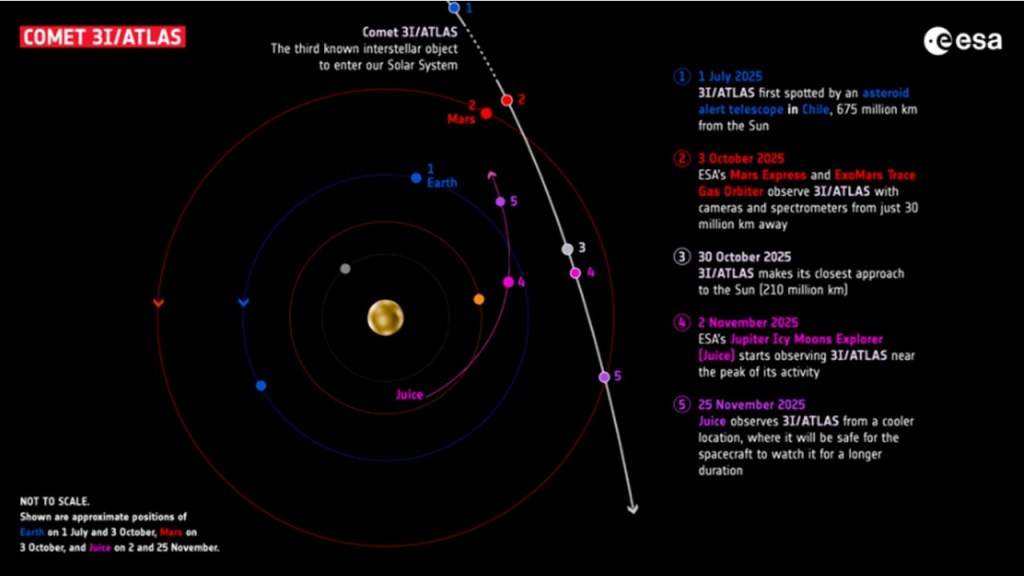
The Asteroid Terrestrial-impact Last Alert System (ATLAS) station at Río Hurtado, Chile, discovered our visitor on July 1, 2025. ATLAS is a NASA-funded global network of telescopes that detects asteroids and comets, and provides early warning of potential impacts on Earth. When the celestial body now known as 3I/ATLAS was discovered in early July, it was just entering the edge of our solar system. By the end of October, it will be at its closest point to the sun, approximately 130 million miles.
Scientists estimate that 3I/ATLAS will come within 170 million miles of Earth later in the year, around December 19th. Certainly not close enough to pose a threat to the planet. It will bid us adieu early next year, exiting the solar system in mid-March.
Where 3I/ATLAS originated from is a mystery, but based upon the trajectory of the comet, it is clearly not from these parts. Scientists speculate that it originated somewhere between 3 and 14 billion years ago, and has been hurtling through interstellar space for millions of years. It is the third known interstellar object to do a drive by of our solar system, following 1I/ʻOumuamua (discovered in October 2017), and 2I/Borisov (discovered in August 2019).
There are plenty of fun facts about 3I/ATLAS, and some puzzling behavior; including its trajectory, emissions, and light signature. Enough oddities to have the interwebs abuzz with speculation, and one Harvard Professor declaring that the comet may be intelligently directed and proof of alien life. Avi Loeb, Professor of Science at Harvard, has spoken extensively on the potential for 3I/ATLAS to be alien, estimating a 30-40 percent probability that it could be an alien probe.
Speculation is rampant across social media, with dozens of commentators on YouTube discussing the comet. One such video caught my ear, with the statement that “If 3I/ATLAS turns out to be alien, it will set the Judeo-Christian worldview on its ear.” The inference is that if we discover alien life, it would somehow disprove the existence of God.
But would it really?
The debate on the existence of alien life, and the implications of that existence for belief in God, is nothing new. In 1958, C.S. Lewis published an essay in the Christian Herald titled “Will We Lose God in Outer Space.” The essay was written, in part, in response to the writings of Professor Fred Hoyle. Hoyle was a distinguished Professor of Astronomy at Cambridge, likely best known for coining the phrase ‘big bang’ as a derisive description for the theory that the universe had a beginning. At the time, Hoyle was an adherent to the steady-state theory that the universe was eternal.
The Big Bang was not the subject of Lewis’ 1958 essay, however. It centered on the possibility for the existence of alien life. In Lewis’ younger years, the prevailing theory was that the universe was inhospitable to life, and life on Earth was a fluke. The abnormality of our existence out of the vastness of space was evidence against a creator who would have any interest in humans.
By the 1950s, that theory was being reversed. Not only was the universe not considered hostile to life anymore, but it seemed increasingly possible that there were multiple globes that were teeming with life. This new theory was also proffered as evidence against a creator, who was deemed unnecessary for a universe where was life was commonplace. If there is life across the universe, what makes us think we’re so special that a creator God would take interest?
For Lewis, the crux of the debate came down to the doctrine of the Incarnation. Specifically, the belief that “… God ‘for us men and for our salvation came down from heaven and was… made man.’ Why for us men more than for others? If we find ourselves to be but one among a million races, scattered through a million spheres, how can we, without absurd arrogance, believe ourselves to have been uniquely favored? I admit that the question could become formidable. In fact, it will become formidable when, if ever, we know the answer to five other questions.”
To put it plainly, if there is life on other planets, have we been uniquely favored by Emmanuel, God with us? Is our need for redemption unique in the universe? Or are we one of many fallen species, or perhaps failed experiments? The five questions Lewis offered for consideration were:
- Are there animals anywhere except on earth?
- Supposing there were, have any of these animals what we call “rational souls”? That is, “are they spiritual animals?”
- If there are species, and rational species, other than man, are any or all of them, like us, fallen?
- If all of them (and surely all is a long shot) or any of them have fallen have they been denied Redemption by the Incarnation and Passion of Christ?
- If we knew (which we don’t) the answers to 1, 2, and 3 and, further, if we knew that Redemption by an Incarnation and Passion had been denied to creatures in need of it is it certain that this is the only mode of Redemption that is possible?
The answers to these questions cannot be known, and offer an opportunity for endless speculation and debate. To parse this down, one can ask, ‘If there is intelligent life on other planets, are they like us, sinners in need of a savior? Or did they perhaps escape the fall? If fallen, were they redeemed as we were, or through some other path?’
Lewis contemplated answers these questions in his own fiction, specifically his Space Trilogy (which was written years before 1958). There is other speculative fiction on this topic as well, my own personal favorite coming from the second season of Star Trek.
In “Bread and Circuses” from 1968, the crew of the Enterprise find themselves on a planet with a civilization that mirrors the Roman Empire. This version of the Empire is technologically advanced, a 20th century version of Rome, with their gladiatorial combat televised. The crew encounters a group of escaped slaves who identify themselves as “children of the Sun.” Their leader is a former Roman Senator who abandoned his position after hearing “the words of the Sun.” These children of the Sun have a clear mission; freedom, love, and universal brotherhood.
Eventually, the crew completes their mission and returns to the Enterprise. Spock remains puzzled that such a technologically advanced society could include a pagan-style group of sun worshippers. Uhura has been monitoring the planet’s communications, and offers a logical explanation; “It’s not the sun up in the sky. It’s the Son of God.” Ceasar and Christ both. Fall and redemption. God incarnate on another planet.
Of course, it’s all speculation. But should we discover intelligent life on other planets, does that somehow disprove God? I think not. It seems to me entirely plausible that the God of the universe, who exists outside of time and space, who is the ultimate engineer, designer, and artist, would have created life elsewhere.
Maybe He did, maybe He didn’t. As Lewis noted with his own five questions, it is not for us to know, at least for now, and may simply be unknowable. What I do know, is that we are a fallen people in need of redemption, Christ has redeemed us, and offers us life with him in the new Earth. He’s a big God, and if he’s done that for other civilizations on other planets, I wouldn’t be surprised.
Perhaps 3I/ATLAS is just a mass of frozen carbon dioxide, or perhaps it’s an alien probe. Either way, my faith in the one who created it is unshaken.
In the meantime, Professor Loeb is advocating for the United Nations to develop protocols for use in the event of extraterrestrial contact. I’m a proponent of Risk Management, and given the size of the universe, it’s probably not a bad idea.
P.A. Tennant – October, 2025
Soli Deo Gloria
Photo: ESA
Copyright 2025 Paul A. Tennant
 P.A. Tennant
I remember that episode of Star Trek so clearly. Funny thing was that might have been the only episode where they DIDN’T violate the Prime Directive.
LikeLike