In November 2005, the United Nations General Assembly voted to establish January 27th as International Holocaust Remembrance Day. At the time, Secretary-General Kofi Annan called the ‘International Day of Commemoration to honour the victims of the Holocaust,’ an important reminder of the universal lessons of the Holocaust, “a unique evil which cannot simply be consigned to the past and forgotten.”1 The 27th of January was selected as the day of remembrance to mark the day in 1945 that the Auschwitz-Birkenau concentration camp was liberated.
Perhaps no organization has worked harder to honor the victims and remind us of those universal lessons than the Shoah Foundation at the University of Southern California. The foundation was established by filmmaker Steven Spielberg in 1994. During the filming of “Schindler’s List” that same year, a number of Holocaust survivors visited the set. Their stories inspired Spielberg to establish a foundation with the mission to record audio-visual testimonies from those who had survived the Holocaust. More than 50,000 personal testimonies have been filmed and archived, establishing a permanent testimonial to the horrors of the Shoah (the Hebrew term for Holocaust), and the resilience of humankind.
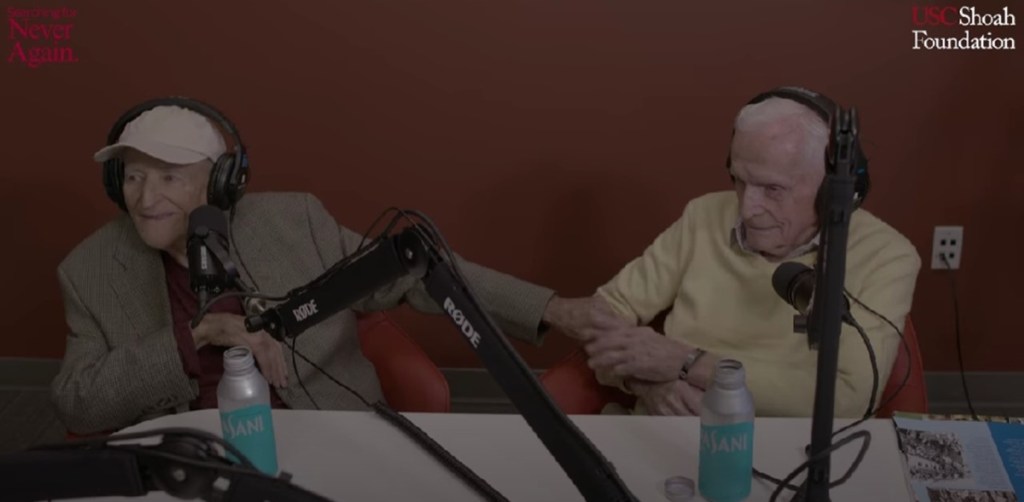
Many of these testimonies can be viewed on YouTube, and the foundation also has other educational venues, including podcasts. In the summer of 2025, Dr. Rob Williams (Chief Executive Officer and Finci-Viterbi Chair of the USC Shoah Foundation) interviewed two remarkable men for the “Searching for Never Again” podcast, a podcast of the USC Shoah Foundation.
Two men, born on opposite sides of the world in the 1920s. One American, one Hungarian. Their paths crossed at Buchenwald in 1945, after the infamous concentration camp was liberated by the US Army. Eighty years later they met face-to-face once again, reunited to record their testimonies with the Foundation.
Andrew Roth was born in Penészlek, Hungary, in 1927. As a young boy, he survived numerous ghettos, and was imprisoned at Auschwitz. When the Soviet Army broke through the German lines and entered Poland, he was transported from Auschwitz to Buchenwald. He endured what he refers to as a “grand tour of concentration camps.”
On April 11th, 1945, Buchenwald was liberated by the U.S. Army’s 6th Armored Division. Roth recalls lying on the ground on his back, afraid to move, having been told to not leave the camp. He looked up and saw a soldier standing above him, with an American flag on his uniform. That young soldier was Staff Sergeant Jack Moran.
Jack Moran was born in Superior, Wisconsin, in 1925. He enlisted in the Army at age 17, and was initially transported to Britain after basic training. The stay in Scotland was short-lived, and his unit was soon making its way across the channel. Moran and company fought their way across the European theater, surviving the Battle of the Bulge, before arriving in Germany and being part of the liberation of Buchenwald.
Prior to liberation, Roth was housed in the ‘kinderblock,’ an infamous section of the camp where the children were held. Among those he was imprisoned with was future Nobel laureate Elie Wiesel. To stave off starvation, Roth would jump the fence into where the German Shepherd Dogs were housed, risking his life to steal two pocketsful of dog food.
Moran has his own harrowing tales to share. The bitter cold and lack of food in the Battle of the Bulge. The single day that saw all four of his best friends killed. The cheapness of life on the battlefield. The horror of what they found at Buchenwald.
Both men survived, and went on to live full lives, even as they lived with the memories of what they’d witnessed. Stories like Roth’s and Moran’s are important to record and store for future generation, yes. But they bear a particularly urgent message now, at a time when radical factions from both the left and the right deny the Holocaust even occurred.
We are now 80 years from the end of World War II, and the last of the eyewitnesses to the war and to the Holocaust are nearing the end of their lives on this earth. The Holocaust is fading from our collective memory, and states across the world have done a poor job at keeping that memory alive, and educating about actual history. This has allowed for the rise of false narratives and lies, many of which might seem new, but are actually decades, if not centuries, old.
And these lies are not the sole provenance of any one ideology. In an interview last summer, Rabbi Menachem Levine was asked who posed a greater threat, the left or the right. His response was “For sure, the far left today.” He was referencing the unholy alliance between left-wing progressives and jihadists that were calling once again for the extermination of Jews. That interview was barely six months ago, however, and those months have seen the rise of popular figures on the right who preach Holocaust denial and other antisemitic nonsense.
It wasn’t too long ago, in the 1990s, when antisemitism was viewed as a far-right extremist issue. Those on both the left and the right condemned this, and antisemitism was viewed as taboo. Fast forward today, as antisemitism and Holocaust denial has festered on both the left and the right, and we are faced with feckless politicians and various talking heads who refuse to denounce the cancer within their ranks. It would seem that it’s up to us to make Jew hatred taboo again.
The official press release from the UN in 2005 stated “The resolution rejects any denial of Holocaust as an historical event, urges States to develop educational programmes that will instruct future generations about the horrors of genocide, and condemns all manifestations of religious intolerance, incitement, harassment or violence against persons or communities based on ethnic origin or belief.”
Maybe it’s just me, but it seems like we could be doing at lot better. Better at educating, better at speaking up, better at defending the truth.
One way to do better, I believe, is by listening to and sharing the stories of those who actually lived through it. Share the story of Andrew Roth and Jack Moran. Share the stories from the Shoah Foundation. Buy a few copies of Elie Wiesel’s “Night” and give them to friends and neighbors.
These stories are important because they’re real. Real people, with real memories, and not manufactured propaganda. These stories are important to share such that we remember the past, and steel our resolve that Never Again means just that. Never. Again.
P.A. Tennant – January, 2026
Soli Deo Gloria
More information on the Shoah Foundation can be found at their website:
The full interview with Roth and Moran is available on YouTube:
———-
Photo: USC Shoah Foundation, Searching for Never Again Podcast
Copyright 2026 Paul A. Tennant
1UN Resolution : https://news.un.org/en/story/2005/11/158642
Website: https://patennant.com
Substack: https://storyroad.substack.com
 P.A. Tennant