“I would like to be known as a person who is concerned about freedom and equality and justice and prosperity for all people.” – Rosa Parks
Under Montgomery, Alabama, city ordinance in 1955, African American users of public transportation were required to sit at the back of the bus, and were further obligated to give up their seat to a white rider if the front should fill up. On December 1, 1955, Rosa Parks was seated in the front row of the rear section, on her way home from her job as a seamstress at a local department store. When the bus driver demanded that she give up her seat so that a white man could take it, she refused. Parks was arrested for violating the city’s segregation law.
Parks’ defiance of the law was spontaneous, but was spurred by much more than just tired feet. She had been a member of the NAACP since 1943, when she was elected secretary of her local chapter. In 1949, she became an advisor to the local NAACP Youth Council. In this role she helped encourage young people to challenge the Jim Crow laws and check books out of the whites only library. Parks had been active in the desegregation effort, and was privy to discussions amongst the organizations leadership that they were planning a challenge to the city’s racist bus laws.
Rosa Parks was not the first woman to be arrested for refusing to give up her seat. Earlier in the year, 15-year-old Claudette Colvin had been arrested for refusing to give up her seat to a white passenger. Just two months prior to Parks’ arrest, 18-year-old Mary Louise Smith had also been arrested for disobeying the same city ordinance. As Reverend King would later recall in his memoir, it was Rosa Parks unique stature in the community, her character and dedication, that finally spurred leadership into action.
In response to Parks’ arrest, the NAACP and other activists quickly called for a boycott of the bus system, and a young Baptist minister named Martin Luther King, Jr., emerged as the leader of the protest. The boycott began on Monday, December 5, 1955, and lasted for a little more than a year. During that time, African Americans carpooled or walked to work, depriving the public transit system of 70% of its revenue.
The Supreme Court struck down the bus segregation law as unconstitutional on November 13, 1956. Weeks later, on December 20, 1956, Reverend King made the announcement, “The year old protest against city buses is officially called off, and the Negro citizens of Montgomery are urged to return to the buses tomorrow morning on a non-segregated basis.” Among the first to get on a bus after the boycott ended was Rosa Parks.
This was the first of many great victories for Reverend King’s non-violent movement. A first victory ignited by one woman’s refusal to give in. In her own words, “People always say that I didn’t give up my seat because I was tired, but that isn’t true. I was not tired physically, or no more tired than I usually was at the end of a working day. I was not old, although some people have an image of me as being old then. I was forty-two. No, the only tired I was, was tired of giving in”
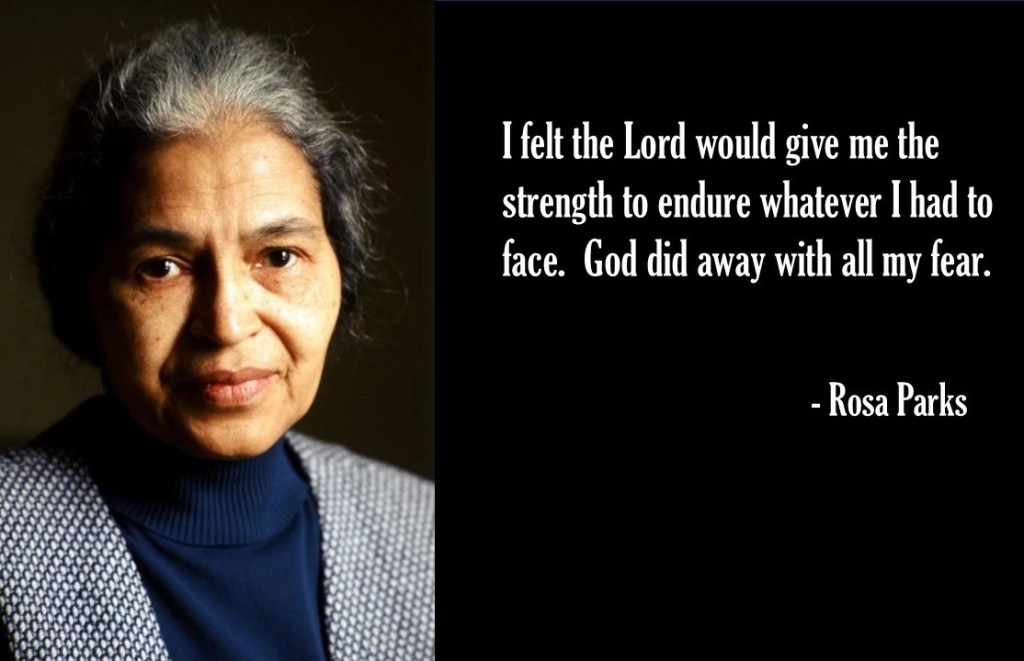
Rosa Parks lived a life of courage and strength, due in no small part to her faith. As she later remarked, “I felt the Lord would give me the strength to endure whatever I had to face. God did away with all my fear.”
Upon her passing in October 2004, the U.S. Senate passed a resolution to honor Parks by allowing her body to lie in honor in the U.S. Capitol Rotunda.
P.A. Tennant – December, 2025
Soli Deo Gloria
Photo: Martin Luther King, Jr., Institute, Stanford University
Copyright 2025 Paul A. Tennant
Substack: https://storyroad.substack.com/
Website: https://patennant.com/
 P.A. Tennant