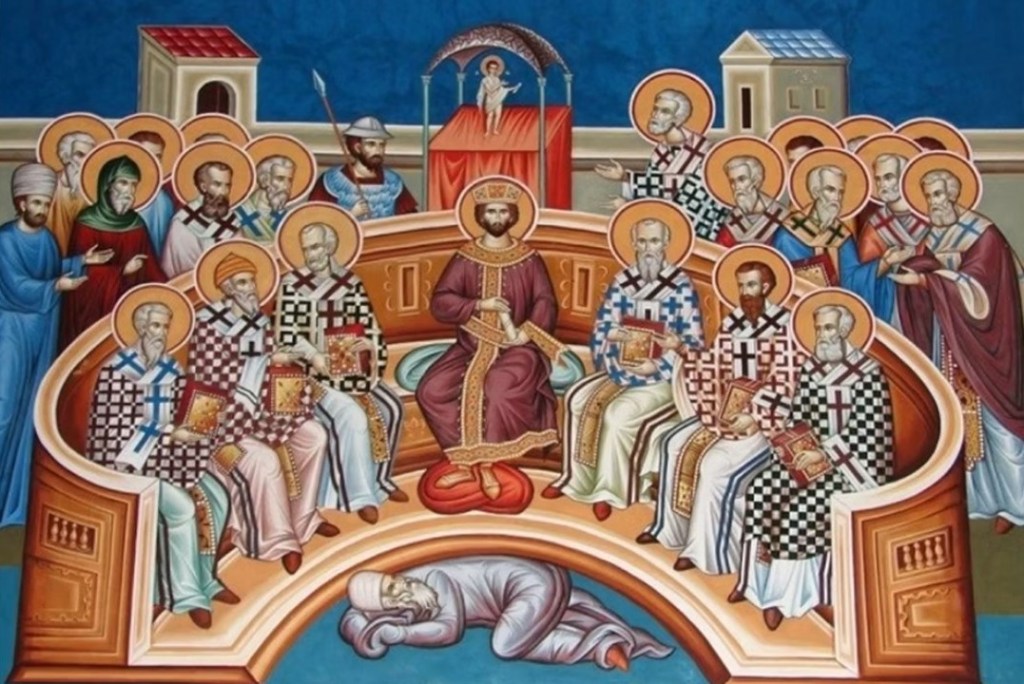
In the early part of the 4th century, a controversy arose between two prominent figures in the Christian church.
Alexander I, the Patriarch of Alexandria, argued that Jesus Christ was eternally begotten by the Father, of the Father’s substance; thereby equal to the Father and without a beginning.
Arius, a priest in Alexandria, countered that Jesus was begotten of God, hence had a beginning in existence, and that “from this it follows there was a time when the Son was not.” Arius’ theology, or Arianism, taught that Jesus was divine, but not eternal. Instead, he was the first created being, and thus not equal with God.
The conflict between Alexander I and Arius made its way to the Emperor. In 325 A.D., Emperor Constantine ordered the bishops to convene in Nicaea (modern day Iznik, Turkey) to resolve the matter.
The outcome of what became known as the Council of Nicaea, was an answer to the fundamental question of the nature of Jesus. An answer deeply rooted in scripture. The Nicene Creed – arguably one of the most consequential documents in church history – is recited around the world, 1,700 years later. Catholic, Orthodox, and Protestant churches all share this as a testament to the belief that Jesus is fully God and fully man. It is a foundational understanding of shared belief, of “the faith that was once for all delivered to the saints” (Jude 3). A shared belief that binds Christians together worldwide, despite differences in doctrine. A shared belief that C.S. Lewis referred to as Mere Christianity.
There were many ideas about the nature of Jesus in the centuries following the resurrection. He was an angel, or an archangel, or perhaps the Angel of the Lord from the Old Testament. The Gnostics, in particular, proffered many beliefs, including that Jesus was an immaterial being who was not human. The Council of Nicaea, reliant upon scripture, rebuked these heresies, and helped lay the foundation for the church in scriptural theology.
One thousand seven hundred years later, heresies still abound. We try to remake God into our image. Jesus has become a pawn, used to justify the political ideology of the moment. Gnosticism, transhumanism, materialism, and other beliefs are alive and well.
So, why is what happened 1,700 years ago important to us today? Sir Isaac Newton famously said, “If I have seen further, it is by standing upon the shoulders of giants.” Today, we stand on the shoulders of giants, whether they be early theologians, great scientists who sought to understand the mysteries and complexity of Creation, or apologists who brought Mere Christianity to the masses.
From our high vantage point, we can see into the past, to the faith that anchors us. And we can see into the future, to the faith that offers the assurance of Hope, Truth and Love.
The world is changing about us, and changing quickly. What happened 1,700 years ago is important today because we need that anchor to hold us firm in a changing world, and give us the blessed assurance that even though the world may change, God is eternal and never changing.
“I believe in one God, the Father Almighty, maker of heaven and earth and of all things visible and invisible.
And in one Lord Jesus Christ, the only-begotten Son of God, begotten of His Father before all worlds, God of God, Light of Light, very God of very God, begotten, not made, being of one substance with the Father, by whom all things were made; who for us men and for our salvation came down from heaven and was incarnate by the Holy Spirit of the virgin Mary and was made man; and was crucified also for us under Pontius Pilate. He suffered and was buried. And the third day He rose again according to the Scriptures and ascended into heaven and sits at the right hand of the Father. And He will come again with glory to judge both the living and the dead, whose kingdom will have no end.
And I believe in the Holy Spirit, the Lord and Giver of Life, who proceeds from the Father and the Son, who with the Father and the Son together is worshiped and glorified, who spoke by the prophets. And I believe in one holy Christian and apostolic Church, I acknowledge one Baptism for the remission of sins, and I look for the resurrection of the dead and the life of the world to come. Amen.”
P.A. Tennant – November, 2025
Soli Deo Gloria
Photo: Icon, Holy Trinity Cathedral
Copyright 2025 Paul A. Tennant
 P.A. Tennant