“Chuck Yeager never needed a safe space.”
I was sitting on a deserted section of beach in the Cape Hatteras National Seashore, along North Carolina’s Outer Banks, with my wife, two daughters, and our two dogs. The sky was perfectly clear, and high above us we could see some fighter jets maneuvering against an endless blue background. We got to talking about flight, aerodynamics, flying faster than the speed of sound, the sound barrier, etc. I told the girls the story about the day Chuck Yeager first broke the sound barrier. How he had two broken ribs and had to use a sawed-off broom handle to pull the canopy closed before his plane was dropped from the belly of a B-29. How even with those broken ribs, getting banged around after being dropped from the bomber, being tossed with the turbulence, he still piloted his craft to Mach 1.07. Which made me think… I bet Chuck Yeager never needed a safe space.
Chuck Yeager was born in Myra, West Virginia, in 1923. At that time, there wasn’t a single airport in all of West Virginia. Yeager didn’t lay eyes on an aircraft until he was 18, after he’d joined the Army.
When the US entered the war in 1941, Yeager, like many young men of that time, volunteered for service. He was a gifted mechanic, able to fix any machine, and was quickly assigned to aircraft maintenance. Yeager soon began to think, though, that his future may lay in the cockpit; “But I noticed that, as a mechanic, my hands were always greasy while the pilots’ were clean — and they had good-looking girls on their arms.”
Initially, the Army was only interested in college graduates as pilots, but by 1942 the requirements were changed to allow 18-year-olds with a high school diploma to enter the pilot program. Yeager was a natural, and was soon flying combat missions over Europe in P-51 Mustangs.
Chuck Yeager distinguished himself in aerial combat, flying 64 combat missions from 1943 to 1945. He shot down 13 enemy aircraft during his combat tour, including four Focke-Wulf (FW) 190s – aka, the Butcher Bird – and one of the earliest German jet powered aircraft. On October 12, 1944, he downed five enemy aircraft in a single day, an ‘Ace in a day’ achievement.
Not every mission was a victory, however. Earlier in the year, on March 5, 1944, Yeager was shot down attempting a head-on run at a squadron of FW 190s over German occupied France. He bailed out of his damaged aircraft and parachuted safely into a wooded area. The next morning, he encountered a French woodcutter, who was able to connect Yeager with the Maquis – the French Resistance.
The Maquis helped Yeager, and three other downed American airmen, escape into neutral Spain. In return, Yeager provided them with training on how to set timers on plastic explosives. During their trek through the Pyrenees, Yeager and one other airman came under fire from a German patrol, and his companion was shot. Yeager tended to his wounds, and dragged him to the top of the mountain, saving his life. Ultimately, they were able to make contact with Spanish authorities, and were returned to their base, where they re-entered the fight.
After the war, Yeager was assigned as a pilot instructor, and eventually as a test pilot. It was in this role, on October 14, 1947, when he became the first pilot to fly faster than the speed of sound. Early that morning, “The XS-1 team presented me with a big raw carrot, a pair of glasses and a length of rope. The gifts were a whimsical allusion to a disagreement I’d had the previous evening with a horse. The horse won. I broke two ribs.”
Despite his injury, Yeager went forward with the scheduled test flight. The Bell XS-1 (later shortened to X-1) was flown aloft in the bay of a B-29, dropped at altitude – which typically resulted in Yeager’s helmet impacting the canopy – where the pilot would engage the rocket motor.
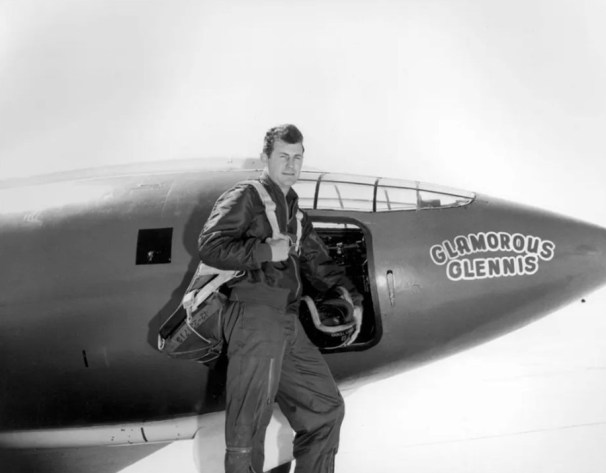
Within five minutes, Chuck Yeager and Glamorous Glennis – the aircraft named after his wife – had broken the sound barrier, reaching Mach 1.07, and ushering in a new age of aviation.
Several years later, on December 12, 1953, aboard a Bell X-1A, Yeager became the first man to fly faster than twice the speed of sound, reaching Mach 2.44.
They’re called the Greatest Generation for a reason. And no, Chuck Yeager never needed a safe space.
P.A. Tennant – October, 2025
Soli Deo Gloria
Photo: Forbes.com
Copyright 2025 Paul A. Tennant
Sources: Forbes.com, Popular Mechanics, ChuckYeager.com, ChuckYeager.org, US Air Force
From Brigadier General Yeager’s official US Air Force biography:
His military decorations and awards include the Distinguished Service Medal, Silver Star with oak leaf cluster, Legion of Merit with oak leaf cluster, Distinguished Flying Cross with two oak leaf clusters, Bronze Star Medal with “V” device, Air Medal with 10 oak leaf clusters, Air Force Commendation Medal, Purple Heart, Distinguished Unit Citation Emblem with oak leaf cluster and the Air Force Outstanding Unit Award Ribbon. He is a command pilot and has flown more than 10,000 hours in more than 361 different makes and models of military aircraft all over the world.
He was awarded the MacKay Trophy in 1948, the Collier Trophy in 1948, and the Harmon International Trophy in 1954.
General Yeager was awarded an honorary doctor of science degree from West Virginia University, in 1948, and an honorary doctor of science degree from Marshall University of Huntington, W.Va., in 1969.
He was promoted to the grade of brigadier general effective Aug. 1, 1969, with date of rank June 22, 1969.
 P.A. Tennant